Restaurant and Catering Answering Service
The phone rings hardest when your crew is busiest. Here's what a restaurant answering service should handle, where it fits best (hint: catering), and what to check before you buy.

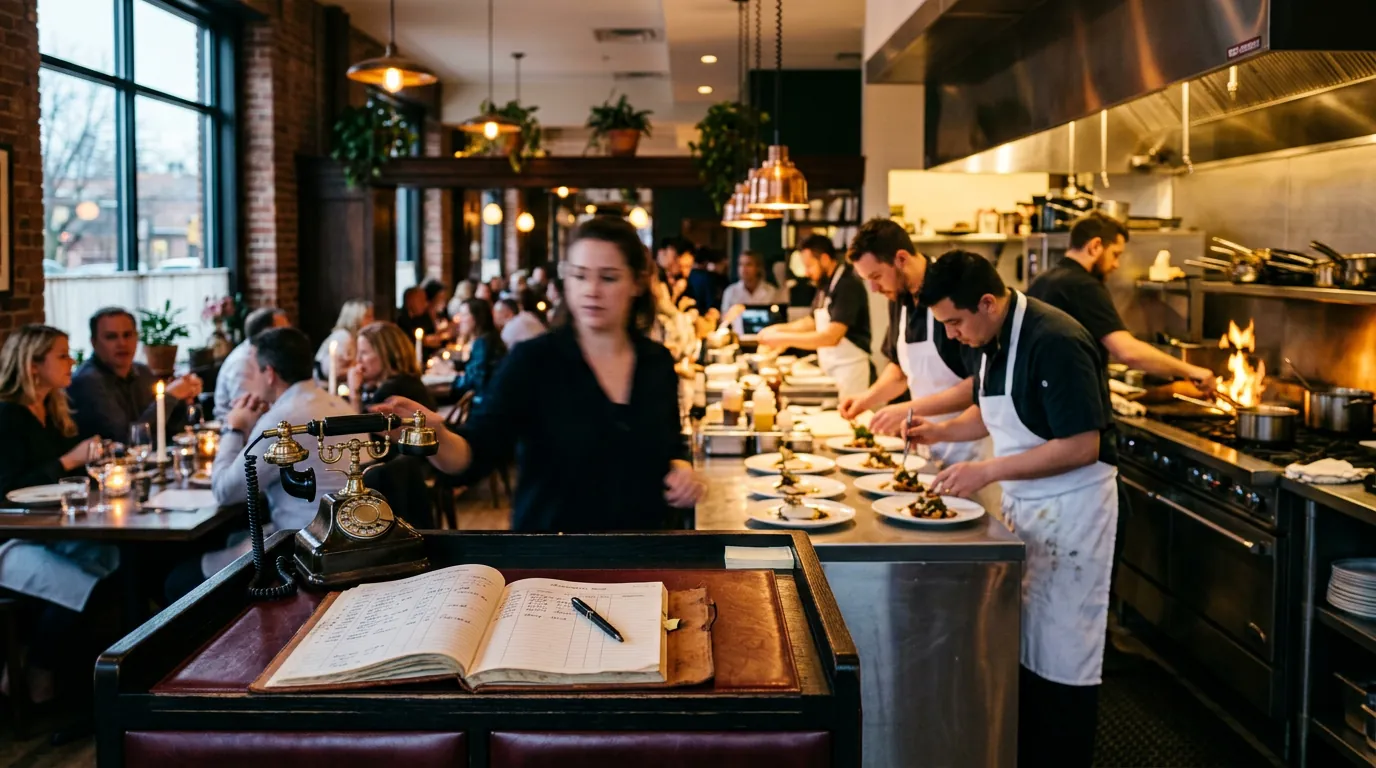
A restaurant answering service picks up your calls when your host is seating a six-top, your line is buried in tickets, or you're closed for the night. It answers the questions callers ask over and over (hours, location, parking, whether you take reservations), takes down reservation and catering requests, and sends the details to you. For most restaurants, the biggest win isn't the dinner rush. It's the catering and private-event calls that ring once, go unanswered, and end up with the caterer down the street.
This guide covers the calls restaurants and caterers actually get, what an answering service should and shouldn't handle, how to price your missed calls, and a checklist for choosing one.
Why restaurant phones go unanswered
Restaurants have a phone problem that other businesses don't: the busiest phone hours are the busiest service hours.
- The rush is when people call. Guests call to ask about a table at 6:30 PM, the exact moment your host is managing a wait list and your manager is expediting.
- Nobody is assigned to the phone. In a lot of independent restaurants the phone belongs to whoever is closest. That means it gets answered fast when it's slow and not at all when it's busy.
- Many calls come when you're closed. People plan dinners, birthdays and office lunches in the morning, on breaks, or late at night.
- Catering sales are often one person's job. If the owner handles catering and is in the kitchen or at an event, inquiries sit in voicemail.
How big is the problem? Toast's guide to restaurant answering services cites data showing restaurants fail to answer about 43% of their calls. Your number may be better or worse. The fastest way to find out is to pull last month's call log from your phone provider and count the missed calls by hour.
The calls restaurants and caterers get
Before you pick a service, sort your calls. Here's how they usually break down, and how an answering service should treat each one.
| Call type | Example | What the service should do |
|---|---|---|
| Quick questions | "Are you open Monday?" "Do you have parking?" "Is the patio open?" | Answer from your info and end the call |
| Reservation request | "Table for four Saturday at 7?" | Take name, number, party size, date and time; send it to you to confirm |
| Large party or private event | "Rehearsal dinner for 30 in October" | Capture full details and flag as important; owner or events lead calls back |
| Catering inquiry | "Office lunch for 40 next Thursday" | Capture date, headcount, location, budget, delivery or pickup, dietary needs; flag as a lead |
| Menu and dietary questions | "Do you have gluten-free options?" | Answer only what you've written down; anything about allergens goes to staff |
| Takeout order | "I'd like to order two large pizzas" | Depends on your setup (see below) |
| Problem or complaint | "My delivery was wrong" | Take details and flag for a manager callback |
| Vendors and job seekers | "Are you hiring?" "I'm your new linen rep" | Take a message, low priority |
The most valuable calls are the bottom of the funnel ones: large parties and catering. A two-top that doesn't get through might call back. A company booking a holiday party usually calls three caterers and goes with whoever responds first.
A word on allergen questions
Be careful here, whoever answers your phone. The FDA lists nine major food allergens (milk, eggs, fish, shellfish, tree nuts, peanuts, wheat, soybeans and sesame). Cross-contact in a busy kitchen is real, and menus change.
A good rule for any answering service, human or AI: it can say what's on your written menu ("we have a gluten-free crust"), but questions about whether a dish is safe for a severe allergy should go to a manager or chef as a callback. Put that rule in writing.
What a restaurant answering service should handle
1. Answer the repeat questions instantly
Hours, holiday hours, address, parking, dress code, whether you take walk-ins, corkage, private room capacity, delivery area. If one person answers these all day, that's hours of staff time.
2. Capture reservation and event requests completely
Every request should end with name, callback number, date, time, party size and anything special (birthday, high chair, accessibility needs). For events and catering, add headcount, budget range, venue address and how they heard about you.
3. Flag what matters
You don't need an alert for "what time do you close." You do want one for a 60-person catering lead or a guest who says they got sick.
4. Get the details to the right person fast
The host stand needs reservation requests. The owner needs catering leads. Look for alerts by text or email and a log where everyone can see the calls.
The takeout question: be honest about the fit
Phone orders are where restaurant answering services differ the most, so think about this one carefully.
If phone orders are a big share of your sales, you probably want a system that puts the order directly into your POS, quotes the total and takes payment. Some restaurant-specific phone ordering tools do that. Ask any vendor exactly which POS they connect to and whether they handle payment.
If phone orders are a small share, or you're mainly a catering business, a general answering service can still help: answer menu questions, point people to your online ordering link, and capture order details for staff to call back and confirm.
Your options
Have staff answer
Free on paper, expensive in practice. Every call pulls someone away from a guest who's already in the building.
Voicemail
Cheap and easy, but most callers who want a table tonight won't leave one. Catering leads might, but you're now racing to call back.
Live answering service
Human operators answer with your restaurant's name and follow your script. Good when you want a person on every call or need bilingual agents. Most plans charge by the minute or call, so busy months cost more.
AI receptionist
An AI voice agent answers every call on the first ring, at any hour, from your information. It's usually the cheapest way to cover every call 24/7 at a predictable price. Features vary a lot (POS ordering, reservation system integrations, languages), so check what each one actually does.
For a deeper look at how these tools work, read our guide What Is an AI Receptionist?. If your gap is mostly mornings and late nights, see our after-hours answering service guide.
Here's how a demo call sounds (example)
This is an illustrative example, not a real customer call.
Jessie: Thanks for calling Harbor Street Kitchen, this is Jessie. How can I help? Caller: Hi, do you do catering? We need lunch for our office. Jessie: We do. I can take down the details and have our catering manager call you back. What date are you thinking, and about how many people? Caller: Next Thursday, around 35. Jessie: Got it. Is that delivery or pickup, and what's the address? Caller: Delivery, 400 Commercial Street. Jessie: Any dietary needs I should note, like vegetarian or gluten-free? Caller: A few vegetarians. Jessie: Thanks. Can I get your name and the best number to reach you? ... Perfect. I've marked this as a catering request, and someone will call you back today.
The owner gets an alert with the caller's name, number, date, headcount, address and notes, and the lead shows up in the portal.
Will it pay for itself? A quick worksheet
Use your own numbers, not someone else's.
- Count missed calls for a typical week from your phone log.
- Estimate how many were catering or large-party inquiries. Be conservative.
- Multiply by your average catering or event order.
Example (illustrative numbers only): A restaurant misses 25 calls a week. Most are quick questions, but say 2 a month were catering inquiries, and you'd have won 1 of them. If your average catering order is $800, that's $800 a month in revenue walking to a competitor, before counting reservations.
If your log shows almost no missed calls, you may not need a service. If it shows a lot of missed calls around lunch and dinner service, you do.
Checklist: choosing a restaurant answering service
Get a clear yes or no on each:
- Answers on the first ring during your busiest service
- Answers 24/7, including when you're closed
- Uses your real info: hours, holiday hours, menu basics, parking, event space
- Captures reservation requests with all the details your host needs
- Treats catering and event calls as leads and flags them
- Sends allergen and safety questions to staff instead of guessing
- Sends alerts by text or email, plus a log of every call
- Lets you keep your existing number
- Predictable pricing at your busiest month (December for many caterers)
- If you need them: POS ordering, payments, reservation-system booking, Spanish or other languages, live transfers to the host stand. Not every service offers these. Ask directly.
- A way to test it before you pay
How MorshedWorx Voice works for restaurants and caterers
MorshedWorx Voice is an AI phone receptionist for small US businesses. Your receptionist, Jessie, answers calls 24/7 using the information you give her: hours, location, menu highlights, event space details, catering basics and any prices you choose to share.
On each call, Jessie answers questions, takes the caller's details, records reservation requests and callback requests, and flags urgent or important calls based on your rules. Urgent calls can be put straight through to your phone on every plan. Every call is recorded with a transcript. After the call, you get an alert by text or email (every call, important only, urgent only, or none), and everything is in your online portal. You can add managers and staff, so your events lead sees catering requests and your floor manager sees the rest. Calls export to CSV.
On Pro and Crew, Jessie can also book tastings or event walkthroughs into her built-in calendar, answer in English or Spanish, and handle website chat. What it doesn't do: Jessie doesn't take payments, put orders into your POS, sync with an outside reservation system, or text callers back. Table reservations are captured for your team to confirm. That makes Jessie a strong fit for catering companies, event-heavy restaurants and places that want every question answered without pulling staff off the floor. If phone orders drive most of your revenue, look for a POS-connected ordering tool.
Setup takes about 10 minutes with the free wizard, or we'll do it for you for $197 one-time. You keep your number and forward calls to the one we give you. Plans start at $97/month for 150 minutes; see pricing.
FAQ
What does a restaurant answering service do?
It answers your calls when staff can't. It handles common questions, takes reservation, catering and event requests, flags important calls, and sends the details to you. Some also take phone orders into a POS.
Can an answering service take reservations?
Most can capture reservation requests (name, party size, date and time) for your team to confirm. Booking directly into your reservation system requires an integration, so ask each vendor which systems they support.
Is an answering service worth it for a catering business?
Often, yes. Catering inquiries are high-value and time-sensitive, and the caller is usually comparing several caterers. Use the worksheet above with your own average order to check.
Should an AI answer allergy questions?
It should only repeat what's on your written menu and send anything about severe allergies or cross-contact to a manager or chef. That rule applies to human operators too.
Can I keep my restaurant's phone number?
Yes, with most services. You forward your existing number to the number the service gives you. MorshedWorx Voice works this way.
Hear Jessie answer as your restaurant
Call Jessie at (207) 309-2098 and she'll answer as a restaurant or caterer. Ask about a Saturday table, a 40-person office lunch, or your patio hours, and hear how she handles it. When you're ready, see pricing. If you don't get at least one new customer within 30 days of going live, we refund your first month.
We build MorshedWorx Voice, the AI receptionist for local service businesses, and help owners answer every call and win more jobs. MorshedWorx is based in Maine.
Hear Jessie answer as your business.
- Answers 24/7 from your own services, prices and hours
- Puts real emergencies straight through to your phone
- Books the job, filters spam, and texts you a summary
- 01Call the demo line from any phone
- 02Tell her your type of business
- 03Ask what your customers ask
- 04Live in about 10 minutes, keep your number
Related reading

Answering Service for Gyms and Fitness Studios
Your coaches are on the floor and your front desk is checking people in when the phone rings. Here's how a gym answering service covers those calls, from trial-class questions to cancellation requests.

Answering Service for Wedding and Event Businesses
Couples call while you're running someone else's wedding. Here's how venues, photographers, planners and other wedding pros can answer every inquiry without stepping off the floor.

Answering Service for Pet Groomers and Boarding
Your phone rings when you're holding a wet, wiggling dog. Here's what a pet grooming answering service should handle for groomers and boarding facilities, and how to pick one.